
Tech Stack
On July 16, 2026, Moonshot AI released Kimi K3: 2.8 trillion parameters, the largest open-weight model anyone has published. Full weights land on July 27 under a modified MIT licence, which means you can download it, fine-tune it, and run it on your own hardware.
Every post I saw about it led with a benchmark screenshot. Almost none of them answered the only question that matters if you are actually paying for tokens: which one of these should I be using, and for what?
So I checked the published figures against the two models most teams actually pay for, and then I did the arithmetic nobody seems to want to do.

The three models, side by side
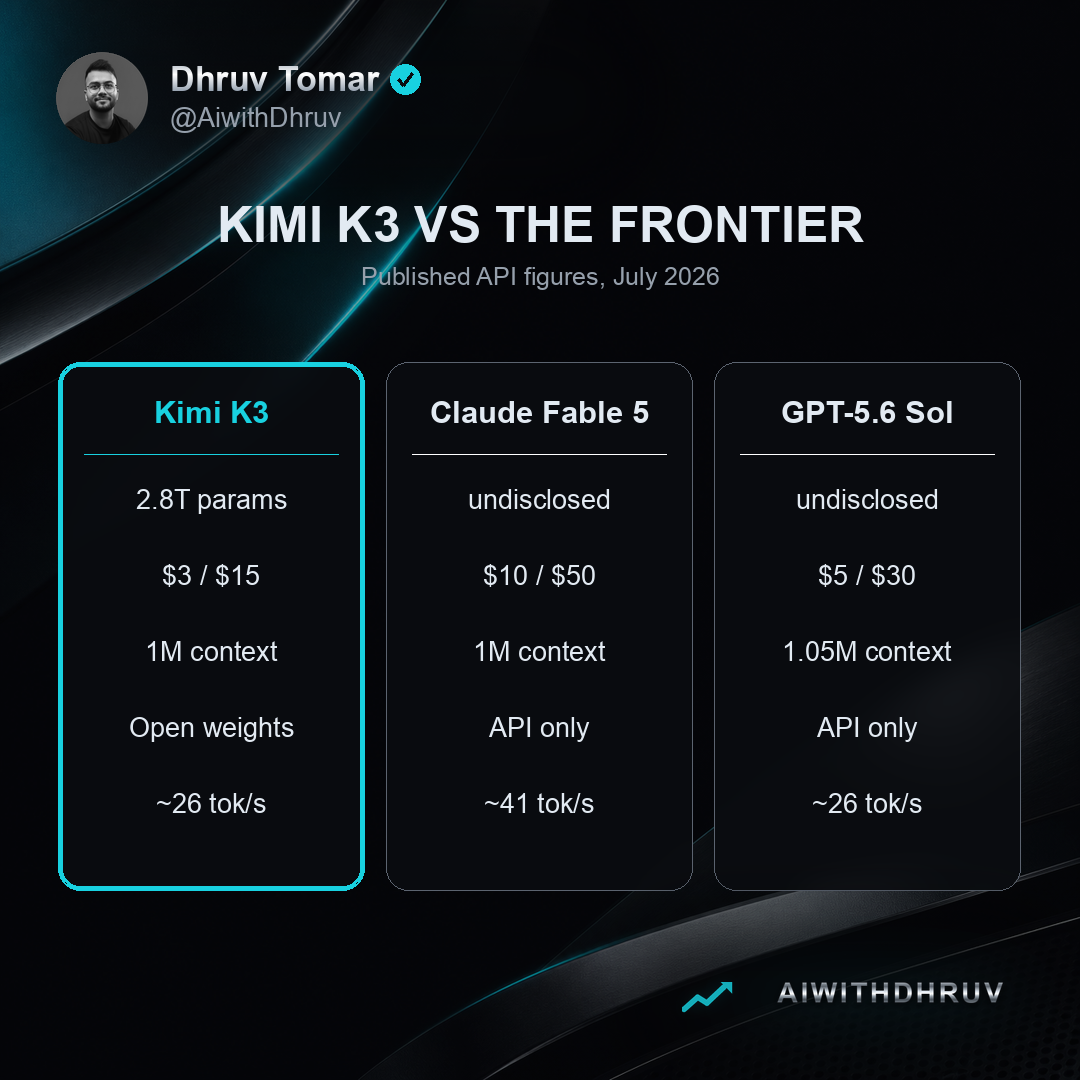
| Kimi K3 | GPT-5.6 Sol | Claude Fable 5 | |
|---|---|---|---|
| Input / 1M tokens | $3 | $5 | $10 |
| Output / 1M tokens | $15 | $30 | $50 |
| Context window | 1M | 1.05M | 1M |
| Throughput | ~26 tok/s | ~26 tok/s | ~41 tok/s |
| Weights | Open (Jul 27) | Closed | Closed |
| Parameters | 2.8T (MoE) | Undisclosed | Undisclosed |
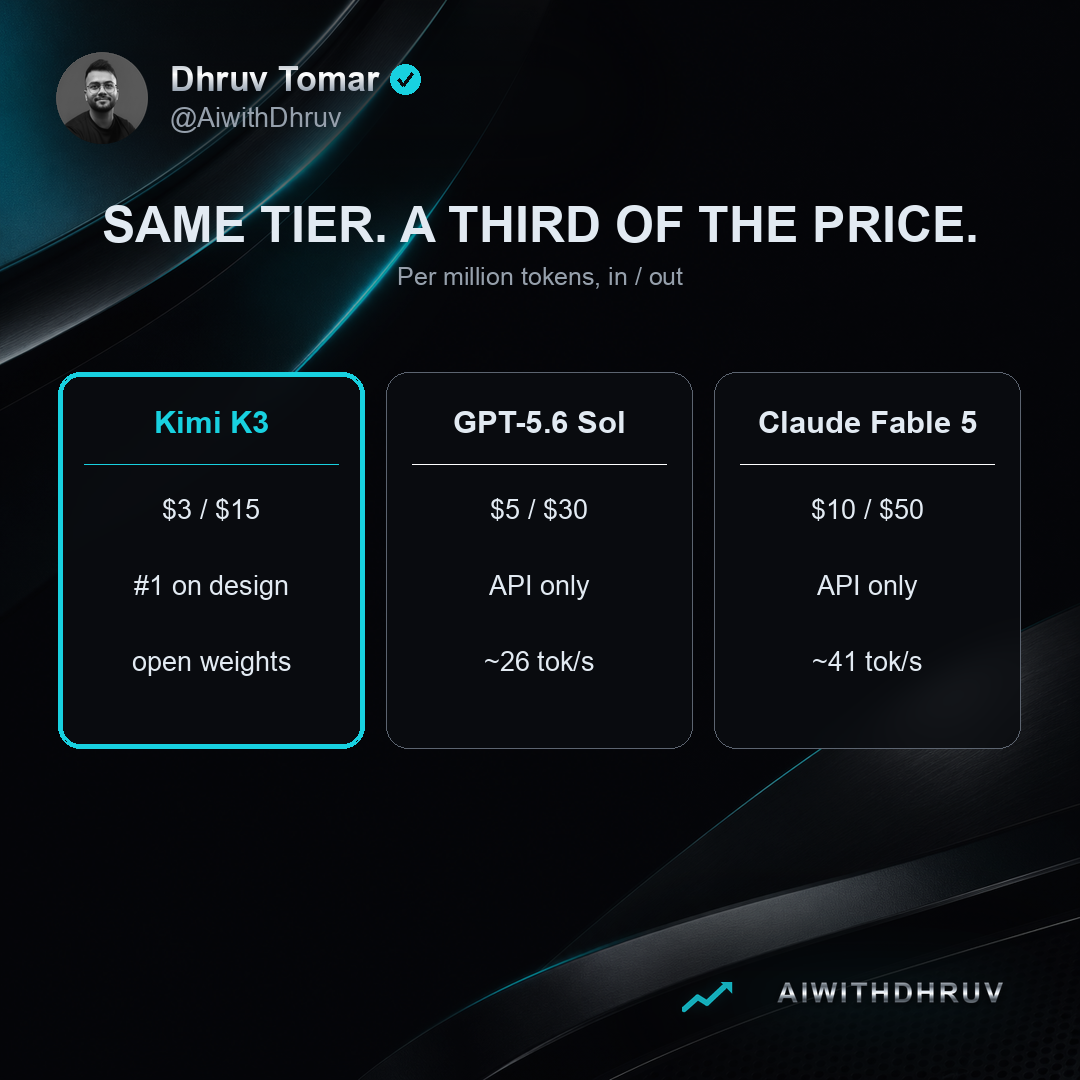
One line in that table deserves more attention than it is getting. Sol generates at roughly the same speed as K3. Slow generation is not a property of open weights — Fable 5 is simply the fastest of the three, and everything else sits together.
That reframes the entire cost conversation, and I will come back to it.
Where Kimi K3 actually wins
This is where most coverage goes wrong in one direction or the other. K3 does not beat everything, and it does not lose across the board. It splits by category, and the split is what tells you where to use it.
Design and frontend work — K3 leads. On the web development arena it does not narrowly edge past Claude Fable 5; it sits ahead by a wide margin. If your work is generating interfaces, layouts, or frontend code, this is currently the strongest model available at any price.
General intelligence — top three. On the Artificial Analysis intelligence index, K3 places in the top three overall, ahead of Claude Opus 4.8, GPT-5.5, Grok 4.5 and Sonnet 5. Two versions ago this model was a budget option. It is now genuinely frontier-class.
Agentic work — competitive. On Next.js agent evaluations it holds its own against Fable 5 rather than clearly beating it. Treat these two as peers here.
Raw speed — it loses, clearly. ~26 tokens per second against Fable 5's ~41. That is roughly a 40% gap and it compounds over long runs.
The cost math nobody is showing you
"A third of the price" is abstract. Here is what it looks like on realistic monthly volumes.
A moderate coding assistant — 10M input, 2M output per month:
- -Kimi K3: (10 × $3) + (2 × $15) = $60
- -GPT-5.6 Sol: (10 × $5) + (2 × $30) = $110
- -Claude Fable 5: (10 × $10) + (2 × $50) = $200
A heavy agentic workload — 50M input, 10M output per month:
- -Kimi K3: (50 × $3) + (10 × $15) = $300
- -GPT-5.6 Sol: (50 × $5) + (10 × $30) = $550
- -Claude Fable 5: (50 × $10) + (10 × $50) = $1,000
At the heavy end, the difference between K3 and Fable 5 is $700 a month — $8,400 a year for a single workload. For a solo builder or a small team, that is not a line item. That is whether the project exists.
One trap to know about Sol: any request carrying more than 272,000 input tokens is billed at 2x the input rate and 1.5x the output rate for the entire request. If you work with large codebases or long documents, Sol's real cost is meaningfully higher than its sticker price suggests. That penalty does not exist on K3 or Fable 5.
What the speed difference actually costs you
Speed is the honest argument for Fable 5, so let us put a number on it too.
A job that produces 100,000 output tokens:
- -At ~41 tok/s (Fable 5): about 41 minutes
- -At ~26 tok/s (K3 or Sol): about 64 minutes
Twenty-three minutes of difference. Whether that matters depends entirely on whether a human is sitting there waiting.
If someone is watching a cursor blink, 23 minutes is unacceptable and Fable 5 is worth every rupee of the premium. If the job runs overnight and you read the output in the morning, 23 minutes is invisible and you just paid triple for nothing.
So which one should you pay for?
Here is how I would actually decide.
Choose Claude Fable 5 when the work is interactive and a person is waiting on output. Pair programming, live debugging, anything conversational. You are buying latency, and it is genuinely the fastest of the three.
Choose Kimi K3 when the work is unattended, high-volume, or design-heavy. Overnight refactors, batch generation, frontend and UI work where it currently leads outright. You are buying throughput per rupee.
Choose GPT-5.6 Sol when you are already committed to OpenAI's ecosystem and tooling. On price and speed against K3 it is hard to justify on the raw numbers — same throughput, higher cost, plus the long-context penalty.
Choose Kimi K3 unconditionally when you need to self-host. Regulated data, air-gapped environments, or simply not wanting a vendor between you and your product. Open weights are not a feature the others can match at any price, and this is the first time that option has also been genuinely good.
The honest caveats
I would rather flag these than have you discover them yourself.
The harness is weaker than the model. K3 is strong, but the tooling around it is less mature than what Anthropic and OpenAI ship. Expect more friction in day-to-day workflow.
It reasons for a long time before acting. Beyond raw generation speed, it spends longer thinking. On simple tasks this feels disproportionate.
Attention to detail needs prompting. Left unprompted it will skip conventions a more opinionated model includes by default. Specify what you want rather than assuming.
Serving capacity is limited. Moonshot is a smaller operation than OpenAI or Anthropic, and throughput reflects that. Self-hosting after July 27 sidesteps this entirely.
What this actually changes
For two years the open-weight model was the thing you used when you could not justify the good one. Capable enough, rough at the edges, obviously a compromise.
That trade is finished. Moonshot priced K3 at roughly four to five times what its own previous version cost — not because they got greedy, but because it is no longer competing in the budget tier. It is competing with the frontier, and on design it is currently winning.
The interesting part is not that a cheaper model exists. It is that for the first time, the option you can download and run yourself is also one of the best options available. If you have ever shelved a project because the inference cost did not work, that arithmetic just changed.
Every figure in this piece comes from published pricing and public arena results. I deliberately left out the hallucination-rate numbers circulating this week — the metric direction is ambiguous and I could only find a single source for them. If you have a second source, I would genuinely like to see it.
One aside, since it changes how much any of this matters: I stopped typing prompts to these models. I dictate them. Most people speak at around 130 words a minute and type at around 45, so a long spec takes a third of the time out loud — and the model does not care which way it arrived. I built the tool I use for it, and it runs Whisper on your own machine rather than a server: IndianWhisper.
Want to build something like this?
I architect and deploy end-to-end AI systems — from MVP to revenue.
Let's TalkOr ask Angelina — my AI twin in the bottom-right corner. She knows my full build history, live GitHub, and how I'd approach your project.