
Tech Stack
I build the software side of AI — agents, pipelines, voice systems. I don't build robots. But on July 9, 1X Technologies put a new hand on its NEO home humanoid, my feed filled up with clips of it plucking grapes and zipping jackets, and I did the thing I always do before I repost anything: I went and read the actual spec sheet.
The hardware is genuinely interesting. The launch is also a masterclass in what a robotics demo does and doesn't tell you — and the lesson lands directly on anyone building AI software today.
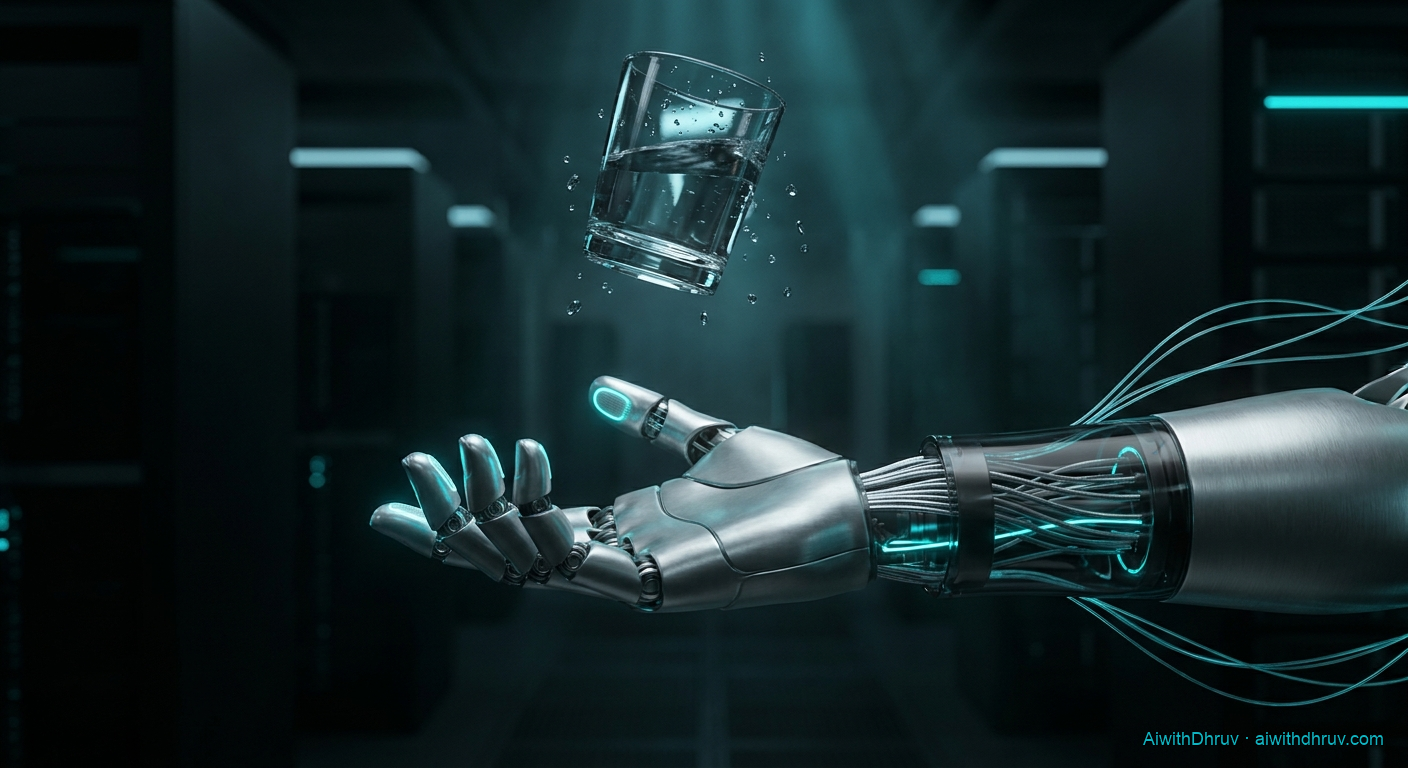
What 1X actually shipped, from their own numbers
Everything in this section is 1X's published spec — no independent teardown exists yet, so treat it as manufacturer claims. With that said, the engineering choices are worth studying.
The hand has 25 degrees of freedom — 22 across the fingers and palm, 3 in the wrist. The motors don't live in the hand at all; they sit in the forearm and drive the fingers through tendons, the way your own forearm muscles pull your fingers. Positioning accuracy is quoted at plus-or-minus 0.2 mm, thumb torque at 3.5 Nm, fingertip flexion force up to 45 N, and the wrist joints are rated for over 2 million cycles. It's IP68 waterproof and built from food-safe materials, because it's meant to work in your kitchen.
Two choices stand out to me more than any single number.
First, the gear ratios are deliberately low — 5:1 to 15:1, where industrial grippers run far stiffer. Low ratios cost you clamping strength but buy you something called backdrivability: push against the hand and it yields, and every joint natively senses force. For a robot that's supposed to operate around your family, being weak-but-aware beats being strong-but-blind.
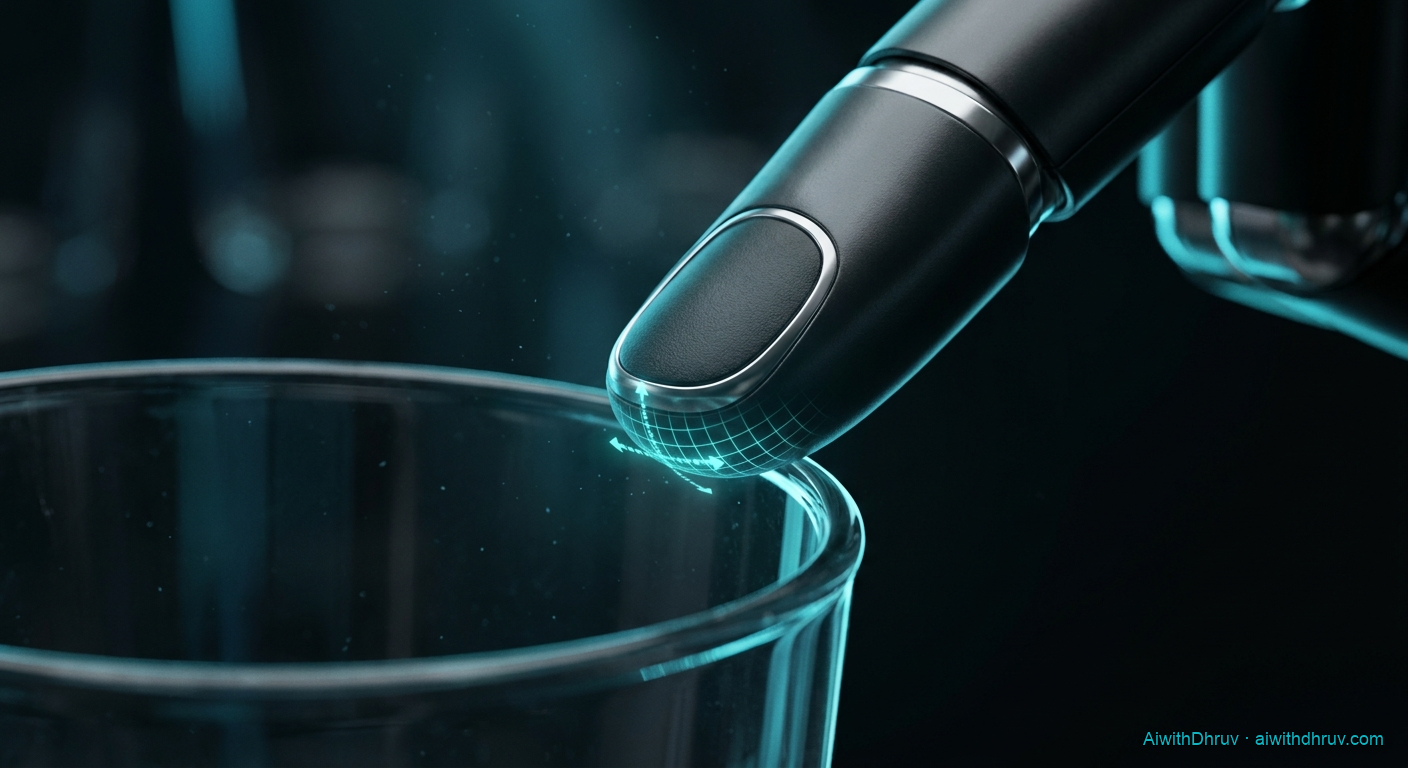
Second — and this is the one that matters — the fingertips and hand surfaces carry tactile skin that senses shear, not just pressure. Grip force tells you that you're holding something. Shear tells you it's starting to slip. That's the difference between holding a glass and catching a glass, and almost no production hand has shipped it.
The real bottleneck was never strength
Here's the pattern I keep seeing, and the reason hands are the choke point of the entire humanoid industry: the hard problem isn't actuation, it's closing the perception-action loop fast enough. A hand that can't feel slip has to grip everything like it might escape — which is how you crush the egg. A hand that senses shear can hold things the way you do: lazily, correcting only when the world pushes back.
If that sounds familiar, it should. It's the same lesson as every AI product I've built: the bottleneck is never model horsepower, it's the quality and latency of the feedback signal. 1X spent their engineering budget on sensing and compliance, not on a stronger grip. That's the right trade, and it's the same trade you should be making in software.
Now the fine print
Watch the launch reel again — the grapes, the tea, the jacket zipper. Nowhere does 1X label which of those clips is the robot acting autonomously and which is a human teleoperating it from somewhere else.
That distinction isn't a nitpick. It's the entire question.
1X is open about their model at the company level: NEO ships with an "Expert Mode," where remote human operators drive tasks the robot can't yet do on its own, and those sessions become training data for Redwood, their in-house AI model. When NEO launched as a home robot last October, reviewers pushed exactly here — one prominent take called it "selling the dream," and a major newspaper's hands-on demo turned out to be effectively driven by a human the whole time. Figure's CEO went further and accused teleop demos across the industry of being staged with "human teleoperators in the next room."
So the honest status of the July demos is: the hand hardware is real, the specs are published, and whether the dexterity you're watching is AI or a person is undisclosed.
Why I still think this launch matters
Here's the part most of the hot takes miss: the teleoperation isn't a scandal. It's the strategy.
Every Expert Mode session is a labeled demonstration — a human solving a manipulation task through the robot's exact body, generating the training data that autonomy will eventually be distilled from. 1X literally describes the new hand as "an API to the physical world." Read that phrase as a software person and the whole launch reframes itself: the hand is the data-acquisition funnel, and the product being built is the model.
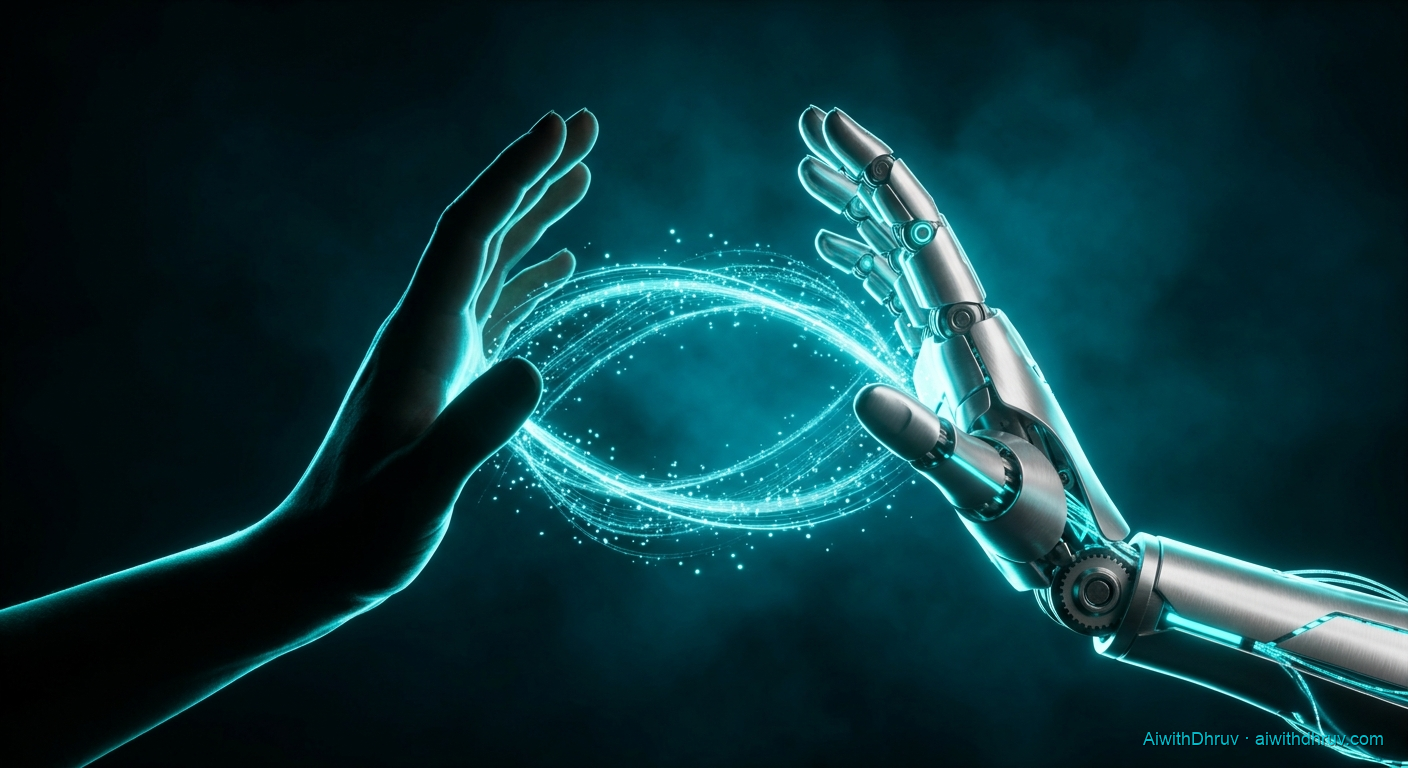
We already know this playbook. It's human-in-the-loop bootstrapping — ship the assisted version, harvest the trajectories, fine-tune toward autonomy. Every serious AI product I've worked on does a version of it. The difference is that in software we usually say so.
So the takeaway for builders isn't "humanoids are fake" and it isn't "the robots are here." It's this: when you evaluate any embodied-AI demo — as an investor, a customer, or just someone deciding what to believe — the first question is not what the hand can do. It's who's driving, and where the data goes. The company that owns the flywheel from teleoperation to training data owns the thing that compounds. The fingers are just the funnel.
That's also the standard I want to be held to: I'd rather tell you which parts of the demo are human than have you find out later.
— Dhruv
Want to build something like this?
I architect and deploy end-to-end AI systems — from MVP to revenue.
Let's TalkOr ask Angelina — my AI twin in the bottom-right corner. She knows my full build history, live GitHub, and how I'd approach your project.